Ear piercing types › Industrial
Industrial Piercing
Preview both holes on the planner →
What is an industrial piercing?
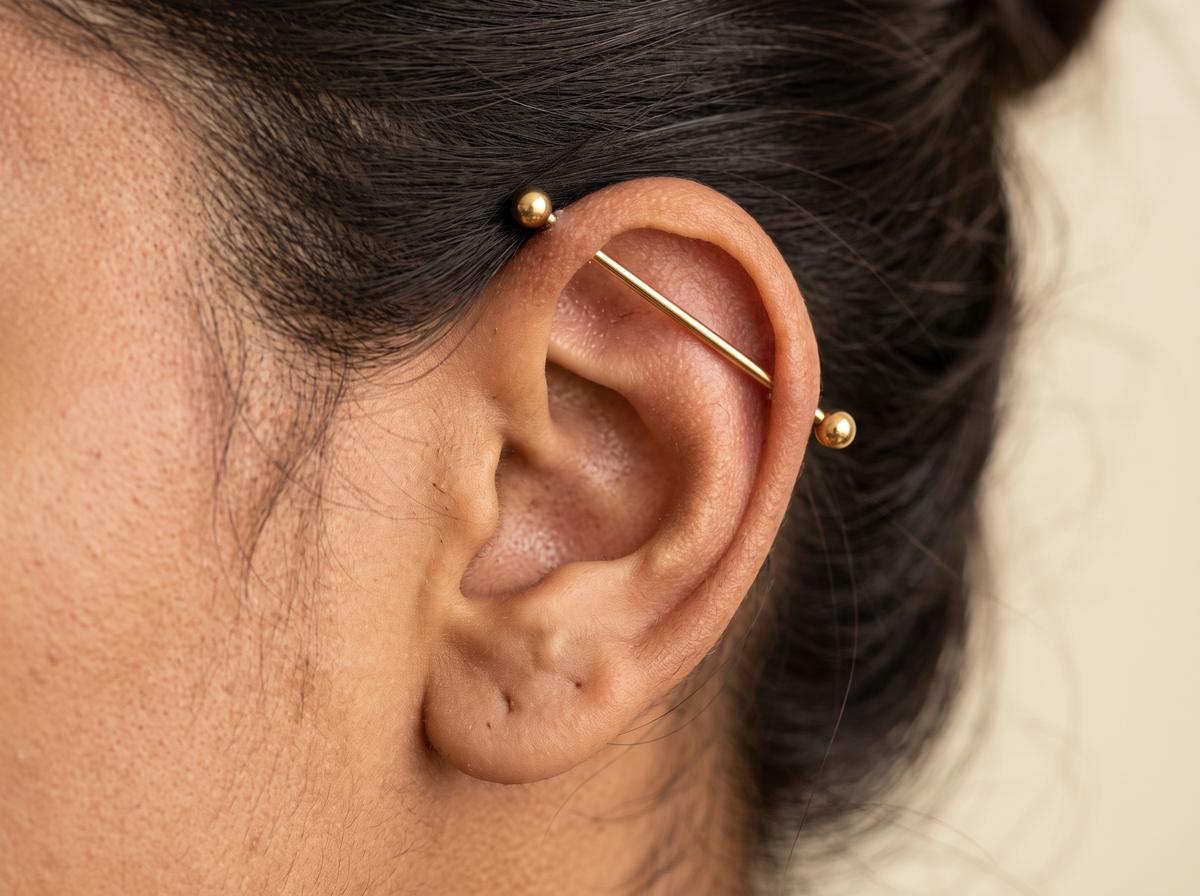
An industrial piercing is two holes in the upper ear cartilage joined by one long, straight barbell. The classic placement runs diagonally from the forward helix area at the front of the upper rim to the helix on the outer rim, so the bar crosses the top of the ear. You may also hear it called a scaffold or construction piercing.
Does an industrial piercing hurt?
Because it's two cartilage piercings done in one sitting, most people rate an industrial around 6–7 out of 10 — more than a single helix. Each needle is quick, but the second one often feels sharper because the area is already tender. See how it compares with every other spot in the ear piercing pain chart.
Industrial piercing healing time and aftercare
Plan on at least 6–12 months, and often closer to a year. Industrials are one of the fussier ear piercings to heal: the single bar links both holes, so a bump, snag or swelling at one end pulls on the other. Don't sleep on that side, keep hair, hats and headphones off the bar, clean with sterile saline and leave the jewelry alone until your piercer says it's healed. If the ear swells a lot, a piercer may temporarily switch to a longer bar or two separate studs.
Industrial piercing jewelry and size
A straight industrial barbell, usually 14g (1.6 mm) and roughly 32–38 mm long depending on your ear. Once healed you can swap in decorative bars — arrows, chains, charms — or switch to two separate helix studs whenever you want a break from the bar.
Typical starting gauge: 14g (1.6 mm). Common jewelry: Straight industrial barbell.
Who can get an industrial piercing?
Anatomy matters more here than for most piercings. You need a well-defined upper rim at both the front and the back of the ear, and the bar has to sit flat without pressing into the cartilage underneath. If your upper rim is flat or folded, a standard industrial may not fit; a good piercer will check first and may suggest a different angle or two separate helix piercings instead.
What to pair it with
An industrial is a statement on its own, so it pairs best with simple lobe studs or a small tragus stud. Avoid crowding the upper ear with extra helix or flat piercings close to the bar. You can test combinations in the ear piercing planner and save the result to show your piercer, or browse curated ear ideas for ready-made looks.
Industrial piercing FAQ
Is an industrial piercing two piercings?
Yes. It's two holes in the upper ear cartilage connected by one barbell, and both are usually done in the same session.
How long does an industrial piercing take to heal?
Usually 6–12 months or longer. Because one bar connects both holes, irritation at one end affects the other, so it often takes longer than a single helix.
Is an industrial piercing more painful than a helix?
Usually yes. An industrial is two cartilage piercings in one sitting, so most people rate it around 6–7 out of 10, a step above a single helix at about 4–5. The second needle often feels sharper because the area is already tender.
Are industrial piercings risky?
They aren't dangerous when a professional does them, but they are one of the harder ear piercings to heal and are more prone to irritation bumps, snagging and lingering swelling, because one bar links two cartilage wounds. Good placement, a correctly sized bar and careful aftercare keep the risk low.
What's the 3/2 piercing rule?
It's an informal guideline, not an official standard, and people use it two ways. As a healing guideline it means not having more than three piercings settling at once, with no more than two of them in cartilage — and a single industrial already takes up two cartilage spots, so piercers often suggest letting it heal before adding more. As a styling tip it means three piercings on one ear and two on the other for a balanced, asymmetric look.
Can anyone get an industrial piercing?
Not everyone. It needs enough upper-rim cartilage at both points and room for the bar to sit flat. A professional piercer will check your ear shape before piercing.
How do I sleep with a healing industrial piercing?
Sleep on the other side — the bar spans the top of the ear, so almost any pillow pressure pulls on both holes at once. A travel pillow is the usual fix for side sleepers.
Can I take the bar out and wear two separate studs?
Yes, but only after both holes are fully healed — usually 6–12 months or more. Many people then alternate: two studs for a lower-profile look, the bar for the full industrial.
How do I clean an industrial piercing?
Clean both holes once or twice a day with sterile saline and pat dry. Keep hair, hats and headphones off the bar — anything that pushes it twists both holes at once.
What gauge is an industrial piercing?
Usually 14g (1.6 mm) with a straight barbell roughly 32–38 mm long, sized to your ear. Your piercer measures the distance between the two holes before choosing the bar.
Pain is a commonly reported range and varies by person. Healing times follow general guidance from the Association of Professional Piercers. This page is general information, not medical advice — always talk to a professional piercer.
Other ear piercings
Helix Forward Helix Flat Rook Daith Tragus Conch Snug Anti-Tragus Auricle Lobe Upper Lobe